the grid is imperfect
on perfection, expression, and starting anyway
(originally posted on substack)
The Paradox of Perfectionism
I think about this quite often: perfectionism being the only force pulling us away from perfecting things, yet there is no "perfect" in real life, it's just our momentary imagination. And it's pretty difficult to unhook ourselves from this idea when we are imagining the best for ourselves.
Learning to Unhook
A few years ago, when I was getting cognitive behavioral therapy, I learned a concept that stuck with me: unhooking.
It's such a small shift in thinking, but it makes a huge difference. The idea is to create space between yourself and the thoughts your mind is having -especially the repetitive ones- the labels, the stories it keeps telling.
For instance, instead of thinking "I'm not good enough," you would reframe it as:
"I'm having the thought that I'm not good enough."
That simple phrasing creates distance. It reminds me that I am not this thought. My brain is simply doing its thing; worrying, preparing for the worst.
And unhooking doesn't remove the thought. But it puts it in perspective. It becomes one single voice in the noise, not the absolute truth.
If you're curious to explore the book, The Happiness Trap talks about these techniques further.
Unhooking From Perfection
What I find especially interesting is how this same unhooking technique works with perfectionism.
During the pandemic, took an online course called In the Studio: Postwar Abstract Painting from MoMA. The point wasn't to copy the artists, but to try creating while thinking the way they did.
In the Agnes Martin lesson video, Corey D'Augustine talks about platonic geometry: the idea that while no perfect triangle exists in nature, yet we can still imagine one. Even though perfection doesn't exist in physical form, we still aspire toward it. This explanation is so relieving to me, in the sense of distinguishing the difference between reality (imperfect) and perfection (a direction, not a destination).
And between these two, between concept and real life, is where unhooking can become a tool again.
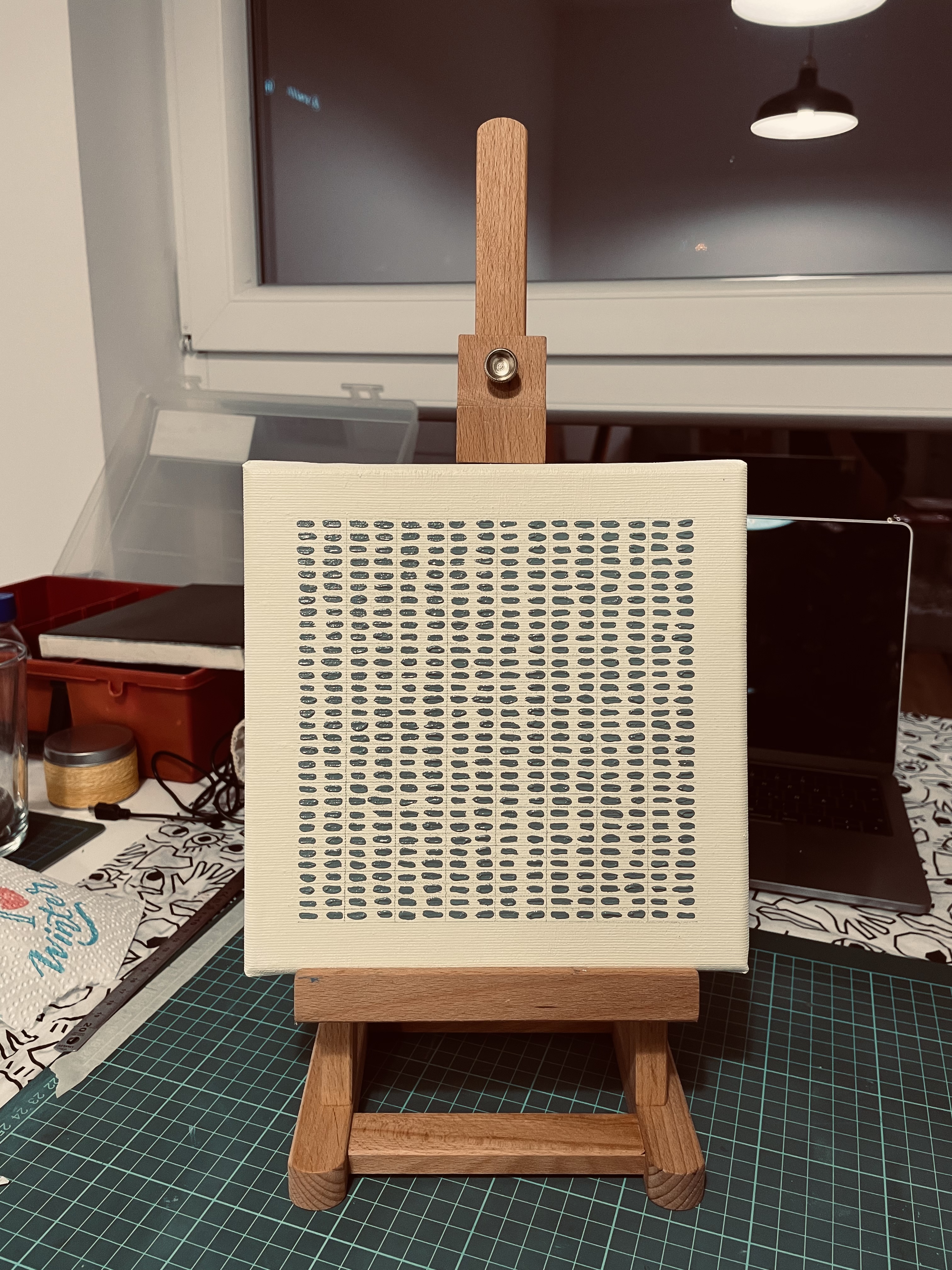
Especially in the moments when we're frozen by the idea of the perfect result, we can unhook ourselves by reminding that reality is about starting with wobbly lines, going layer by layer, with a gentle push towards a geometric precision. And if we fuss too much, we have the option to start again.
As part of that course, I tried to replicate one of Agnes Martin's grid works, here's how mine turned out:
Why This Hit So Close to Home
This idea is so relieving. That there is no perfection anyways; and the only way out is unhooking from this ideal; and by working with wobbly lines together, making the perfection. It hits so close to me partly because of how I work and how I identify myself.
I've never been the fast thinker in the room. I can't improvise easily. I'm not the person with instant answers. I tend to start slow and clumsy and then work quietly on something until I feel ready to show it.
That's why I find comfort on iteration. It makes the process less scary.
And also, I find this exciting. That the process of iteration itself is something I find fulfilling. Because it encourages me to stay slow and stupid.
Bear with my references but there is an amazing article about this, which explains why it's a joy and why it's important to be comfortable with this feeling: The Importance of Stupidity in Scientific Research:
"One of the beautiful things about science is that it allows us to bumble along, getting it wrong time after time, and feel perfectly fine as long as we learn something each time."
It also maps well with the idea of compound gains. Measured but anyways wobbly lines, drawn with the aspiration of clear, straight ones each time, makes the compounded corrections over time, which eventually creates the "perfect" impression.
Iteration in the Wild
This mindset—of starting scrappy and learning by doing in iterations, makes me think about content creation and how people are actually doing that today. And strangely, TikTok comes to my mind
What makes TikTok stand out is how it invites imperfection. Unlike Instagram, which rewards mostly aesthetic, or YouTube, which demands production value, TikTok lowered the bar overall, maybe because it started as the cringe platform. But later evolved quickly with abundance of both cringe and diverse quality. You don't need a strategy or an aesthetic, you just need a moment of "whatever". That looseness creates space for feedback loops for any type of content. People post more frequently, get more instant reactions, adjust accordingly, and get better. At least this is how i perceived the platform evolution.
And what's even more fascinating is how that happens inside niche corners of the platform. Micro-communities form around any type of content and create a dialogue under comments which is more direct, reddit like, the feedback more immediate. What I am saying, it's not only broadcasting, you're more of a interactive dialogue. That's why, TikTok comes to my mind.
Lot's of references already but as I said, I've been thinking about this for a while and maybe it was my selective perception connecting all the reads. This shift, of showing up imperfectly and evolving with your audience, also remoins me this post Learn in Public, the idea that you don't have to wait until something's ready to share it. The act of sharing is the learning.
Expression as Unhooking
With those observations being the inspiration, I would like to "write more" to practice expressing myself more.
This has been a longing for me for a while, to share and learn in public.
But I have to admit, I kept thinking blogging is dead. Nobody reads anymore, nobody has time for it; we listen while commuting, or we watch before sleep.
Especially with AI exploding all sorts of mediums, and our brains now wired to scroll, skip, flip; I believe I don't read either.
But then I realized, I still do, even more intentionally, if I find a trace of genuine thought in the middle of all this AI mess.
And to Understand More
AND, I think this urge to share also comes from a deeper part of my personality. I'm a reserved person by nature, although in certain roles or environments, I can push myself to act against that nature, (what Brian R. Little calls a "free trait.") And although there is nothing wrong with being reserved, I find it quite limiting on personal growth.
Because I think self-expression is also a way to understand yourself. When you speak less, write less, express less, you define yourself less. And when things go undefined, when there's no outlet, no rephrasing or reframing, you start relying solely on how things "feel".
You float in emotions. You might cry, laugh, might feel high or low, but still not know exactly what you're feeling. That lack of clarity can become a trap.
Simply because the less I express myself, the less I hear defining myself. And if there is no outlet to work on that definition, I give more control to the hook, to my emotions, to the background noise in my head that nobody hears.
From that perspective, expression, putting things into words, clearly and out loud, becomes a way to unhook yourself.